In 2024, South Africa was ranked 42nd globally and the highest in Africa on the Global Index on Responsible AI. This ranking highlights the country’s relative strength in establishing a foundation for ethical AI governance compared to other nations. South Africa’s digital infrastructure is considered relatively advanced, placing it within the top 20% of countries worldwide. This suggests a solid base for supporting AI technologies in terms of connectivity and foundational digital resources.
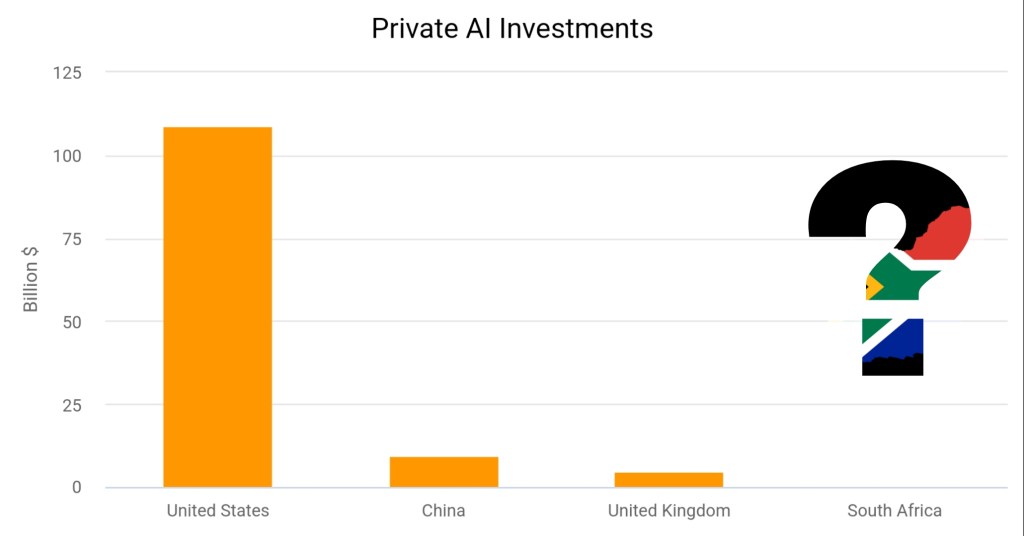
However, a comparison of private AI investment reveals a significant disparity when looking at global leaders. In 2024, the United States saw a staggering $109.1 billion in private AI investment, dwarfing China’s $9.3 billion and the United Kingdom’s $4.5 billion. While specific overall AI investment figures for South Africa in 2025 are not detailed in the provided snippets, its status as one of Africa’s leading AI markets suggests a growing but likely smaller scale of investment compared to these global powerhouses.
A critical factor to consider is the level of digital skills within the population. Data from UNESCO indicates that only 15% of the South African population possesses basic ICT skills, and a mere 5% have advanced skills. These figures likely lag behind those of more developed nations, potentially hindering the widespread and sophisticated application of AI. Moreover, the approach to AI adoption in South Africa has been described as largely business-led, contrasting with the more policy-driven strategies observed in countries like Kenya and Nigeria. This difference in approach can influence the speed and direction of AI integration. It is also worth noting that, in a broader African context, overall AI readiness is considered comparatively low, with only a limited number of countries having implemented comprehensive national AI strategies or policies.
South Africa possesses several notable strengths in its journey towards AI adoption. The country stands out as a leader in responsible AI governance within Africa, demonstrating a proactive approach to addressing the ethical implications of this technology. Its relatively well-developed digital infrastructure provides a solid technical foundation for the deployment and operation of AI systems. The AI market within South Africa is experiencing growth, with increasing integration of AI across key sectors of the economy, indicating a growing awareness and acceptance of its potential. The government’s recognition of AI’s significance is evident in the development and release of the National AI Policy Framework, signaling a strategic commitment to fostering its growth and responsible use. Furthermore, there is a growing momentum in research and innovation efforts related to AI within the country, as reflected in the increasing number of AI-related publications.
Weaknesses
High-performance computing
Foundational challenges persist in areas such as the availability of high-performance computing resources and the establishment of effective data-sharing frameworks, which are crucial for advanced AI research and applications.
ICT and related skills
The limited proportion of the population with high-level ICT skills poses a significant constraint on the talent pool required to drive AI innovation and implementation.
Funding
The funding landscape for AI startups and the provision of incentives for SMEs in this space appears to be uneven, potentially hindering innovation and broader adoption.
Lack of a national strategy
The business-led nature of early AI adoption, while demonstrating initiative, may have resulted in a less coordinated and potentially fragmented approach compared to countries with strong central policies.
Job loss concerns
Finally, concerns regarding economic inequality and the potential for job displacement due to automation remain pressing issues that need careful consideration as AI adoption expands.