Originally published: 03/10/2025
Last updated: 15/01/2026
Written by Anza Kutama, BLEC Research Lead
Edited by Tinashe Machokoto, BLEC Business Development Lead
Article contents
- Introduction
- The context and cost of load shedding
- Eskom’s structural transformation necessitated
- Critical voices: concerns and challenges
- Looking forward
Introduction
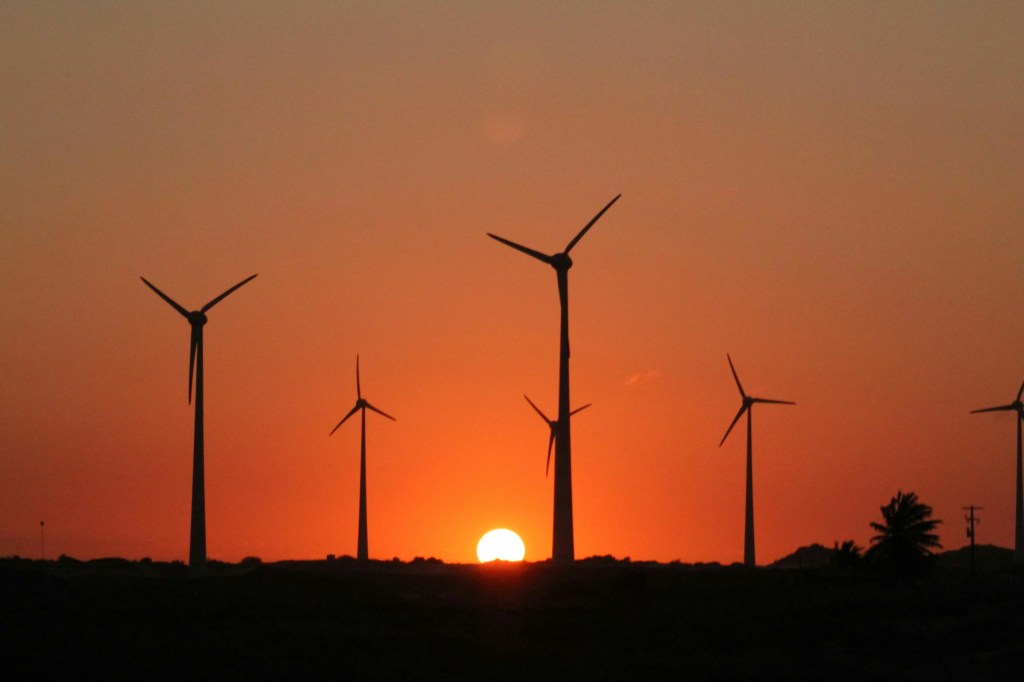
In our 2025 BLEC Ecosystem Report article series, with the first being Transnet, the second SOE opening up its monopoly to the private sector is Eskom. All the information here is from various Eskom posts since 2023.
Since August 2024, the utility provider has been consistently announcing the number of days since loadshedding whenever they reach more than a 100. The countdown restarts whenever loadshedding hits somewhere, but according to Eskom, the country has experienced loadshedding for a total of only 26 hours between April 1 and September 25, 2025, meeting more than 97% of electricity demand in the current financial year. This presents a dramatic improvement they attribute to Eskom’s Generation Recovery Plan for which the consistent days of no loadshedding have led to predictions of 2% GDP growth for South Africa over 2025 (Eskom; 2024).
This article looks at the successful establishment of NTCSA as a separate transmission company that commenced trading on July 1, 2024 and then the initial 291MW solar PV capacity offered through public-private agreements (PPAs) ranging from 5 to 25 years.
We end with a substantive analysis of likely concerns based on standard public-private partnership challenges in the energy sector, including risk allocation and contract structure concerns, execution risks given Eskom’s historical project delivery challenges, and regulatory uncertainty during the transition period.
The context and cost of load shedding
South Africa’s energy crisis reached its peak in 2023, when businesses faced frequent interruptions ranging from Stage 2 to Stage 6 load-shedding, crippling productivity and forcing many SMEs to either invest in expensive backup power solutions or face closure. For context, Stage 2 is meant to shed 2,000MW and consists typically 2-4 hours of outages per day. Stage 6 is meant to shed 6,000MW and consists up to 12 hours daily without power in multiple slots (Eskom; 2025).
For an SME, Stage 6 meant potentially losing half or more of their operating hours. Imagine a small bakery that needs to start production at 3 AM – if their power slot is off from 2-6 AM, they can’t meet morning demand.
The disruptions caused delays in manufacturing as raw materials could not be supplied on time. As a result, SMEs were forced to invest in generators, uninterruptible power supplies, and inverter systems. For context, basic generator setup cost is between R50,000 and R200,000, UPS/inverter systems cost R30,000 to R150,000, and monthly fuel/maintenance/repair costs are about R5,000 to R20,000. All these could represent 6-12 months of profit for a small business. These become capital expenditures that divert resources from not just growth and innovation, but the fundamental stability of a business.
So then a business has two choices: pay up these costs or risk complete shutdown during outages, lose customers to competitors with backup power and therefore face potential permanent closure. SMEs employ about 60% of South Africa’s workforce. When these businesses struggled, they couldn’t hire new staff, many had to retrench existing employees, had to reduce wages or move to part-time arrangements, and this amplified South Africa’s unemployment crisis.
This context helps explain why Eskom’s renewable energy program is so significant – it represents hope for predictable, stable power supply that could allow SMEs to rebuild and return to their crucial economic role. Businesses moved to find new avenues of reliable power, and began looking to private players selling alternative energies like solar.
Private sector transitioning from the grid
The Eskom cycle of enterprise failure driven by energy instability contributes directly to a phenomenon where grid demand is now systematically destroyed. As businesses fail or invest in self-generation, Eskom’s customer base shrinks.
To service its substantial debt load, which remains above R400 billion, Eskom is compelled to apply for significant tariff increases to the National Energy Regulator of South Africa (NERSA). These rising tariffs then accelerate the migration of remaining, solvent industrial customers toward alternative supply options, thereby creating the existential pressure that necessitated Eskom’s pivot to the Renewable Energy Offtake Programme (REOP).
Eskom’s structural transformation necessitated
The Renewable Energy Offtake Programme is a direct outcome of Eskom’s mandated structural turnaround, involving the unbundling of the vertically integrated utility into three separate functional divisions: Generation, Transmission, and Distribution.
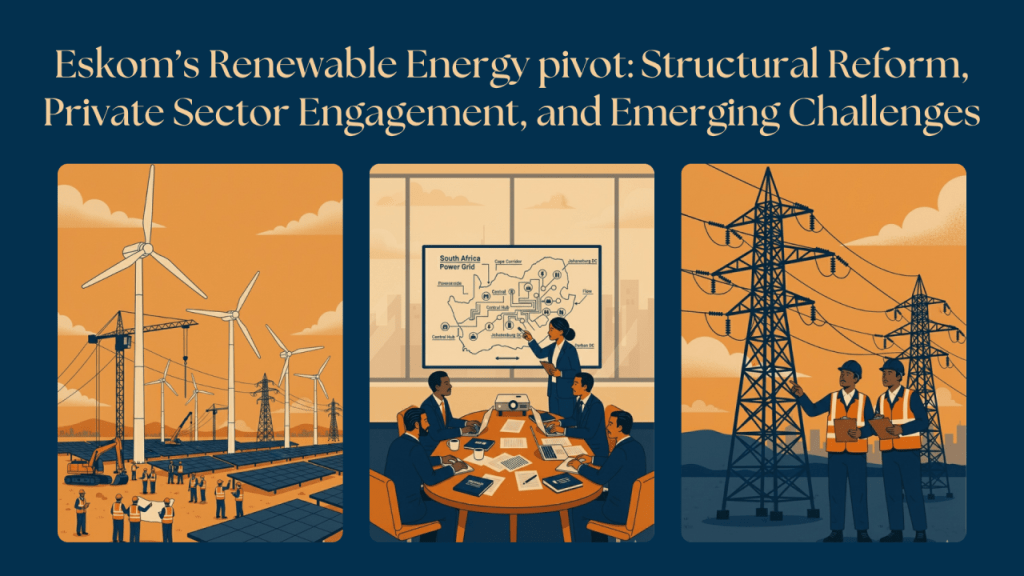
The National Transmission Company South Africa (NTCSA) officially commenced trading on July 1, 2024, marking the successful establishment of the transmission entity as a separate, duly constituted company. The separation is designed to allow independent power producers to compete on equal footing with Eskom’s generation assets. It represents a crucial step toward grid neutrality, ensuring fair access for all generators regardless of ownership, but might also seem to be a fundamental departure from the utility’s traditional centralised, coal-dependent model. But this is merely groundwork laying for Eskom’s diversification toward renewable energy by way of private partnerships.
Status and Governance of the Three-Way Structural Split
While the NTCSA (transformation) has now been legally separated and launched, the distribution and generation divisions are still in the process of being formally established as part of this unbundling. So we won’t talk much about them here.
The unbundling process overall has faced delays stemming from legislation and government policy, but significant milestones have been reached. For NTCSA, the National Energy Regulator of South Africa (NERSA) has formally published the three licenses required for the entity to begin its operations, signifying progress in establishing its legal foundation as an independent subsidiary of Eskom Holdings (Eskom; 2023 & International Trade Administration; 2024).
The goal for the unbundled entities in terms of structural autonomy is to achieving greater governance agility, establish a competitive market positioning, and enhance the execution of complex Public-Private Partnerships (PPPs) and Special Purpose Vehicles (SPVs) (Eskom; 2025), which we can now dive deeper into in terms of REOP.
The Renewable Energy Offtake Programme (REOP)
Eskom’s Request for Proposals (RFP) for the REOP was issued in August 2025, inviting offers for 291MW of Solar Photovoltaic (PV) capacity offered through Power Purchase Agreements (PPAs) ranging from 5, 10, 15, 20, up to 25 years. The renewable energy here consists of solar photovoltaic (PV), concentrated solar power, onshore wind power, and small hydro, among others. The application deadline was set for September 19, 2025. The overall program targets 2GW of construction-ready renewable projects by 2026, with ambitious plans to scale up to 32GW, including green hydrogen capabilities, by 2040.
To ensure rapid execution, by way of skills and expertise, an Invitation To Tender (ITT) was also sent out. Applicants were evaluated on criteria including a proven track record in establishing renewable energy companies, expertise in IPP (Independent Power Producer) business models and financial structuring, and specific experience in creating PPPs and SPVs (Eskom; 2025).
Eskom’s first large-scale commercial renewable energy project was the Sere Wind Farm in Western Cape, which achieved full commercial operation in April 2015. Under REOP, the first renewable plants are expected to come online by December 2027. This timeline might provide some certainty for businesses planning their energy transition strategies while allowing Eskom to gradually set the foundations for its renewable portfolio.
However, it is worth noting that this internal repositioning is taking place simultaneously with aggressive legal efforts to block external competitors, specifically electricity traders, from entering the market (Daily Investor; 2025). This duality suggests that the ultimate strategic objective is not simply broad market liberalisation, but rather the creation of an Eskom 2.0 that can retain dominance in the energy sector, but through emerging clean energy. According to SolarPower Europe’s Global Market Outlook for Solar Power 2025-2029, South Africa’s solar PV market grew sustainably in 2024, adding 1GW (14.1% growth) after a 2023 surge driven by severe load shedding. The country now operates over 8GW of solar capacity across all segments (PV Tech.org; 2025). Eskom wouldn’t want to stay in the sideline of this growth. So it’s a concern of guaranteeing the financial sustainability of Eskom’s generation assets under a modernised structure. The REOP serves as the first major commercial vehicle for this. (1.4k)
Critical voices: concerns and challenges
First is a quick overview of concerns, and then a regulatory scrutiny.
The primary criticism focuses on risk transfer: due to Eskom’s substantial debt, the Public-Private Partnership (PPP) structure leverages on corporate buyers’ balance sheets. This is evidenced by the requirement for bidders to provide performance bond guarantees from either one of the two Eskom-approved financial institutions, effectively shifting offtaker credit and payment risk onto private companies, sidestepping Eskom’s own distressed balance sheet but also potentially stabilising its revenue for up to 25 years.
Risk allocation within long-term PPAs (5–25 years) also raises issues, particularly around performance risk, grid stability, and force majeure. Analysts also question the competitive pricing offered by Eskom, given that coal still dominates its capacity at 82%. With renewable costs falling, critics argue current pricing models may prove inflexible and misaligned with future market conditions.
The utility’s track record with large-scale projects, particularly the troubled Medupi and Kusile coal plants, has left some stakeholders skeptical about its capacity to deliver renewable projects on time and within budget while simultaneously managing its debt and the complexities of the grid. Some suggest Eskom’s role as intermediary adds cost and complexity compared to direct IPP-consumer deals, while the program’s 291MW cap is seen as too limited for market demand. Last but not least in the quick summary list of criticisms is that integrating renewables into a coal-centric grid will demand costly infrastructure upgrades.
Regulatory and policy uncertainty: Convergence with other national departments
The renewable energy offtake program operates within a complex and evolving regulatory environment. With the unbundling process still incomplete and energy sector reforms ongoing, private partners face uncertainty about future regulatory changes that could affect their investments.
We’d like to differentiate between the REOP and the national programme – the Renewable Energy Independent Power Producer Procurement Programme (REIPPPP). The REIPPPP is conducted by the Department of Mineral Resources and Energy, and was initiated in 2010 as a key component of the national Integrated Resource Plan (IRP).
In REIPPPP, private companies act as independent power producers, they are the generators and sellers of electricity. In its capacity as the state utility, Eskom acts as the buyer (Offtaker). It signs long-term power purchase agreements with these IPPs to purchase the power generated, which is then fed into the national grid.
The REOP is Eskom’s first major commercial mechanism designed and executed by its new, unbundled Generation subsidiary. Here, it’s the other way around – Eskom is the generator and seller of the power. The 291MW of capacity being offered is generated from Eskom-owned renewable energy sites. Here private commercial and industrial customers are the buyers (the Offtakers) . And just like the first, they sign long-term PPAs (5 to 25 years) directly with Eskom to procure the power.
It’s key to understand this when you then scrutinize the points we make later in this article about regulations and policy agreements being a drag when it comes to Eskom’s unbundling. This intercept between the Department of Mineral Resources and Energy’s initiatives and Eskom’s unbundling presents a host of complexities when it comes to the trading of power in South Africa.
Looking forward
Eskom’s Renewable Energy Offtake Programme represents a crucial pivot in South Africa’s energy transition, offering hope for businesses that have suffered through years of energy insecurity. The program’s success will depend on addressing legitimate private sector concerns about risk allocation, pricing transparency, and execution capabilities.
The positive momentum is undeniable – Eskom has met ~97% of demand since November 2024 due to less loadshedding, contributing to predictions of 2% GDP growth. This improved performance, combined with the structural reforms and renewable energy initiatives, suggests a more stable energy future for South African businesses.
However, the true test will be in the implementation. As applications have closed in September 2025, attention now turns to how Eskom will manage the selection process and structure the final agreements. For SMEs and large corporations alike, the program offers a pathway to energy security and sustainability, but only if the execution matches the ambition. The coming years will reveal whether Eskom can successfully transform from a struggling monopoly into an effective facilitator of South Africa’s renewable energy future.