Originally published: 23/09/2025
Last updated: 15/01/2026
Written by Anza Kutama, BLEC Research Lead
Edited by Tinashe Machokoto, BLEC Business Development Lead
Article contents
- Transnet structures
- Routes – Corridors
- Operations (Trade) with the rest of Africa
- Criticisms by private players
- Challenges
- Opportunities
Transnet structures
Transnet has opened its railway network to private players through a new slot allocation process, with the first phase of third-party access recently completed in August 2025. Before this, the freight-logistics entity has had a decline in performance driven by a combination of factors.
Among the most prominent issues are persistent system maintenance problems, widespread vandalism, and significant operational inefficiencies. Transnet’s grip on South Africa’s freight logistics industry has been on a decline for more than a decade.
This is clearly reflected in the drop in rail volumes, which plummeted by 33.1% from 226 million tons in 2012 to just 151 million tons in 2023.
And as much as their hold has decreased, there haven’t been alternative entities stepping up to fill the gaps. And this is not because they don’t exist, but because the railway network system was owned by the government, through Transnet, for which the system was closed out for private players.
Routes – Corridors
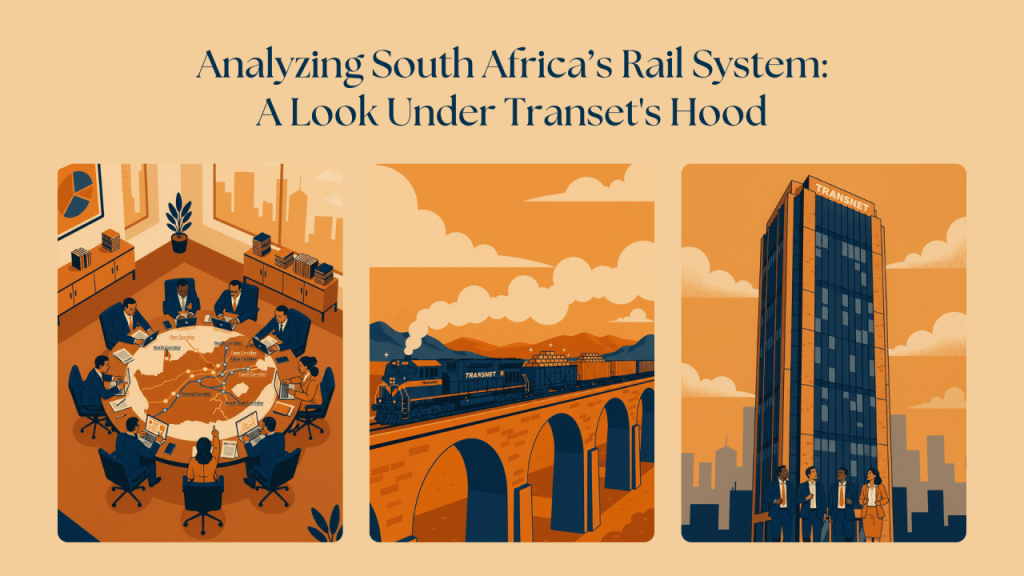
This decision by the state-owned entity marks a major milestone in the effort to revitalise the country’s freight logistics. And as of the publishing of this article, 11 companies have been selected to run operations across 41 routes on the six key freight corridors within the country;
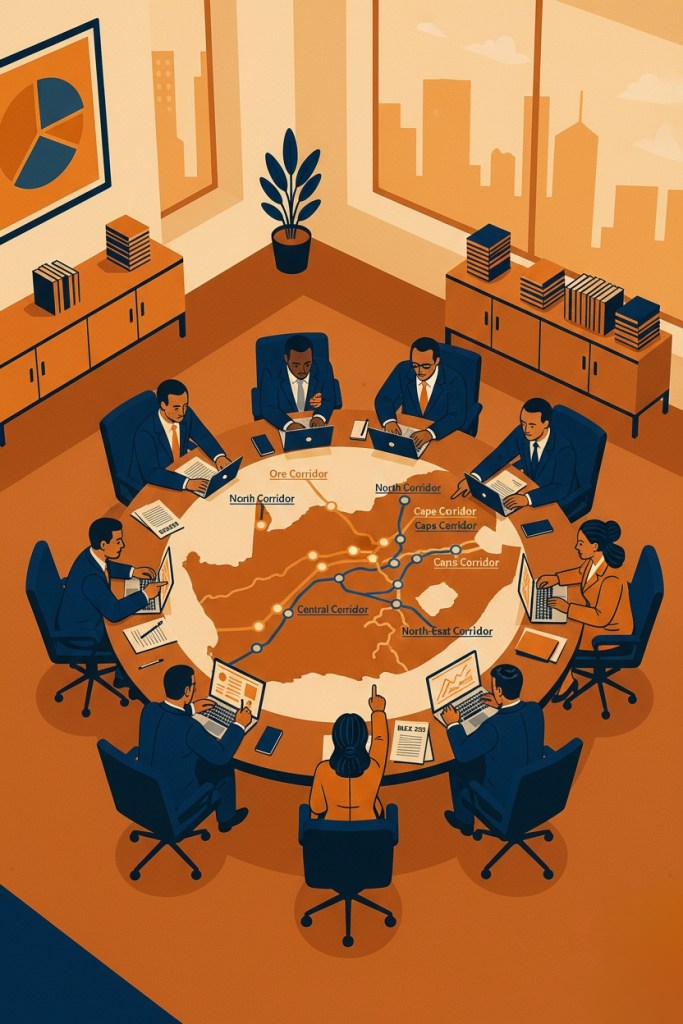
- Ore Corridor (iron ore, manganese and other commodities. Stretches from Northern Cape to Western Cape),
- North Corridor (exports coal to Richards Bay from Mpumalanga, Limpopo and KwaZulu Natal),
- Cape Corridor (manganese. Runs from the Northern Cape and connects to the Ports of Gqeberha, East London and Cape Town),
- Container Corridor (containers, fuel, grain, motor vehicles, coal, chemicals, FMCG general and other cargo),
- Central Corridor (Connects to the five other corridors and spans Gauteng, Mpumalanga, Free State, and North West), and
- North-East Corridor (strategically links the South African rail freight network with that of other SADC countries, mainly via Eswatini, Zimbabwe, Mozambique, Zambia and the DRC. Carries 14% of Freight Rail’s volumes).
We can group ore and cape into that category transporting mainly commodities, the north is for electricity, the container is quite general, while the central plays a connective role for all the corridors. The latter corridor, north-east, plays into South Africa’s mission to better integrate with the rest of Africa through models and institutions like the AfCFTA.
Operations (Trade) with the rest of Africa
The weakening hold of operational control by Transnet over the years has had implications when regular businesses are moving their goods across and beyond the country. It’s important to note that South Africa is a major exporter to other African countries. In our research and collection of data, one logistics director said he “Had to go through countless emails, WhatsApp and normal calls just to end up failing to export maize grains and mealie meal by train from South Africa to the Democratic Republic of Congo.” South Africa is the DRC’s third largest importer, behind Zambia and China (The Observation of Economy; 2025). By having a weakening export system through logistical failures, South Africa risks falling behind other countries, namely India and Belgium, who are 4th and 5th respectively in exporting goods to the DRC. This would also apply to other countries as well.
Projected improvements
The development of the slot allocation process marks a significant reform in the sector where such problems can be solved. The move is expected to add 20 million tones of freight by 2026/27, boost efficiency, reduce costs, improve port access for exporters, and help the network reach 250 million tones by 2029. And the 11 selected companies will now be moving on to further negotiations and contracting with the SOE.
Criticisms by private players
Although the move marks an unprecedented milestone, some criticism certainly exists. An observer from Rangel Logistics Solutions – an air, sea, and road logistics operator with offices in Mexico, Brazil, Angola, Mozambique, Cape Verde, Tanzania, Zambia, and South Africa – noted that while opening 41 freight rail routes to private operators seems promising, key questions remain unanswered. He questions as to “Who will fund and manage the rehabilitation of lines neglected for 30 years? Where will reliable locomotives and wagons come from, given Transnet’s shortages? If infrastructure remains state-owned, how will private operators protect their investments in upgrades?”
The contracts have a range between one and 10 years, requiring port access, rolling stock, and safety permits. He further notes that “Expecting companies to commit millions for licenses that run for only 10 years, seems unrealistic without longer-term concessions or stronger guarantees. Transparency is also overdue; the public still doesn’t know which 10 of the 25 operators were approved or which routes they’ll each run.” Logistics firm, Grindrod, has confirmed access. The truth is South Africa does desperately need a functioning rail network to ease our clogged roads and boost exports. But unless these issues are addressed openly, “This move may become just another policy that looks good on paper but fails in practice”.
Challenges
The key challenges of this initiative include the process of ensuring safety compliance across multiple operators, maintaining fair access and avoiding monopolistic behaviour on key routes, and guaranteeing that private sector gains will align national economic goals.
A leader of Expert Global Consulting Agency – based in Johannesburg, Morkel Erasmus, proclaims that access to the railway network is one thing, but thinks “planning slots and effective asset utilisation and access across state and private equipment will be a challenge, as well as getting that equipment maintained in South Africa”.
Furthermore, substantial investment in the security of the lines will be imperative. But opportunities exist to curb theft and vandalism, such as drone tech.
Opportunities
For the first time ever, private companies will be able to access and operate on the state-owned rail infrastructure. The Minister of Transport, Barbara Creecy called this “a step toward a future where our railways drive economic growth, job creation, and sustainability.”

The initiative has the promise to reduce transport costs for manufacturing, agriculture, and mining. South Africa could improve its regional growth prospects by providing faster bulk transport to neighboring countries, which could ultimately serve as a model for other African nations to look towards public-private partnerships in reviving critical infrastructure.
Due to the failing rail system, South Africa relies heavily on trucks to transport goods. This has resulted in a high number of trucks on roads, which cause 9.4% of all fatal crashes despite being only 3.3% of all vehicles. Such heavy truck reliance could be reduced through this program, shifting more cargo from congested highways back onto rail. And last but not least, private investment may create thousands of new jobs in logistics, operations, and maintenance. The South African government has already provided R149 billion in guarantees, and may fund R35 billion more this year.
A Signaling Engineer at HollySys Rail, a Beijing based transportation intelligence firm with operations in South Africa thinks that this move might bring back some branch lines. “My hope is that industrialists take on this idea and have factories near these branch lines, revitalising towns that were once up and coming such as Blaney, Makhanda, Sterkstroom, Richmond, etc”.
This step by Transnet is part of South Africa’s broader strategy to utilise public-private partnerships in modernising the economy, and it’s a shift that could reshape the country’s transport and trade landscape, if implemented effectively!
In a following article, we looked at how Eskom is conducting the same strategy through its renewable energy offtake program that follows the splitting up of Eskom into three separate divisions. Read here.